November 26, 2026
In October 1915, a vineyard on the southeast face of Warrior Mountain stayed above freezing through a cold snap. The U.S. Weather Bureau had placed four thermometers about two miles northwest of Tryon. The first stood on the Pacolet River valley floor at 950 feet. The second and third were in observer W. T. Lindsey's vineyard and a small apple orchard above it. The fourth was 1,100 feet above the valley station, within 400 feet of the summit. During the cold spell of October 9 to 12, 1915, only the top station reached freezing, and only for one hour each night. The valley floor and the vineyard stayed above 32°F.
Tryon's reputation for mild winters rests on that study. The study itself describes a specific band partway up a specific slope. For anyone looking at a home on one of Tryon's mountainsides, the thermal belt is a position you can check on a particular lot. It is not something the town's name gives every property.
The findings were published in 1923 as "Thermal Belts and Fruit Growing in North Carolina." They came from 68 stations at 16 mountain-region sites, with field work that began in 1912. Tryon was one of the southernmost locations. The report placed the area's warmest nighttime air near the vineyard station or a little above it, roughly 400 feet above the 950-foot valley floor. That puts it close to 1,350 feet. The report also says the height of that warm layer moved with the weather.
The vineyard station sat 380 feet higher than the valley base, yet its average maximum temperature was only half a degree lower, and on sunny days it was sometimes warmer. Height alone did not make a site cooler. On the nights that mattered, the warm air sat partway up the mountain.
The report also noticed the terrain around the slope. It names Tryon Mountain at 3,231 feet and Warrior at 2,465 feet, with Round Mountain between them. It notes that Melrose Mountain, across the Pacolet valley, was too far away and too small to shape Warrior's air. Even in 1915, the warm zone depended on which way a slope faced and what stood around it.
NCpedia's entry on the isothermal belt places the zone mainly in Rutherford and Polk Counties. It says the effect usually forms on southern slopes that higher mountains shelter from the north and northwest. Silas McDowell of Franklin coined the term in 1858. The same entry says residents and scientists have sometimes exaggerated the belt's advantages.
NC State Extension's vineyard site-selection guide explains how it works. On clear, calm nights the ground cools the air touching it. That denser cold air drains downslope and pushes warmer air up above the valley floor. During a strong inversion, a slope can run 10°F warmer than the valley below. Thermometers on one property can differ by 3 to 5°F across just 50 vertical feet. Polk County's 2010 comprehensive plan goes further. It describes the county as within a thermal belt and says slopes may be as much as 20°F warmer than valleys, usually in spring and autumn.
At 3 to 5°F per 50 vertical feet, two homes on the same mountain road can have different frost mornings, and so can the high and low corners of a sloped lot.
Tryon's growers have long paid attention to these differences. In a 2022 Tryon Daily Bulletin profile, Parker-Binns Vineyard manager Cory Lillberg recounted an 1865 account. It credited Tryon's temperate climate, drainage and air circulation with suiting grapes. The same profile names the nearby ridges: Tryon Peak, White Oak, Warrior, Melrose and Hogback.
The area became the Tryon Foothills American Viticultural Area, a federal wine-region designation, on October 29, 2025, as the Tryon Daily Bulletin reported. NC Wine lists Mountain Brook Vineyards, Overmountain Vineyards and Tryon Cellars in Tryon, and Parker-Binns Vineyard in Mill Spring. Overmountain winemaker Sofia Lilly told Our State that Mountain Brook, Overmountain and Parker-Binns share the thermal belt's rolling hills, with "microclimates within microclimates." People who grow grapes here for a living treat the belt as a patchwork of sites. A homebuyer can look at a lot the same way.
The belt lowers the odds of frost. It does not prevent winter. Tryon's long-running weather station, COOP station 318744 at 1,200 feet, records an average first fall freeze of November 3 and an average last spring freeze of April 5. Those averages come from records spanning 1917 to 2019, per NC State Extension's frost-date table. By Thanksgiving week, the long-term average says Tryon has already had its first freeze.
Big storms reach the slopes too. A Tryon Daily Bulletin retrospective on the storm of March 13, 1993, ran under the headline "The Day the Thermal Belt Came Unbuckled." It recorded 9.5 inches of snow in Tryon and the closure of I-26 at Columbus. The belt shows up on clear, still nights. It does little against a weather system that covers the whole region.
The belt's benefits show up on calm frost nights in spring and fall. That means earlier blooms, a longer season in the garden and fewer mornings scraping the windshield. Steep driveways and snow days are still part of owning on the mountain.
The best time to test a slope is a clear, calm, cold morning. In a fast market, few buyers get to wait for one. Polk County's market is not fast this fall.
Canopy MLS's October 2026 Polk County report shows homes that sold in October took 96 days on market, up from 60 in October 2025. Sellers received 86.9% of their original list price in October, down from 91.5% a year earlier. The county had 188 homes for sale at the end of October, a 7.8-month supply.
The median price moved sharply. It was $505,000 in September 2026 and $375,000 in October 2026, a month with 24 closed sales. The report notes that small samples can make percent changes look extreme. The year-to-date figure is steadier. The median through October 2026 was $445,000, compared with $449,900 for the same period of 2025. Prices are roughly flat for the year. What changed is the pace of sales and how far asking prices are coming down.
Ninety-six days on market spans more than a season. A buyer touring a south-facing parcel on a mild afternoon in November can go back on a clear December morning. They can see where frost settles on the lawn and where it doesn't, and whether the low end of the driveway is white while the porch is dry. In a market selling at 86.9% of original list, a seller is more likely to wait for that second visit.
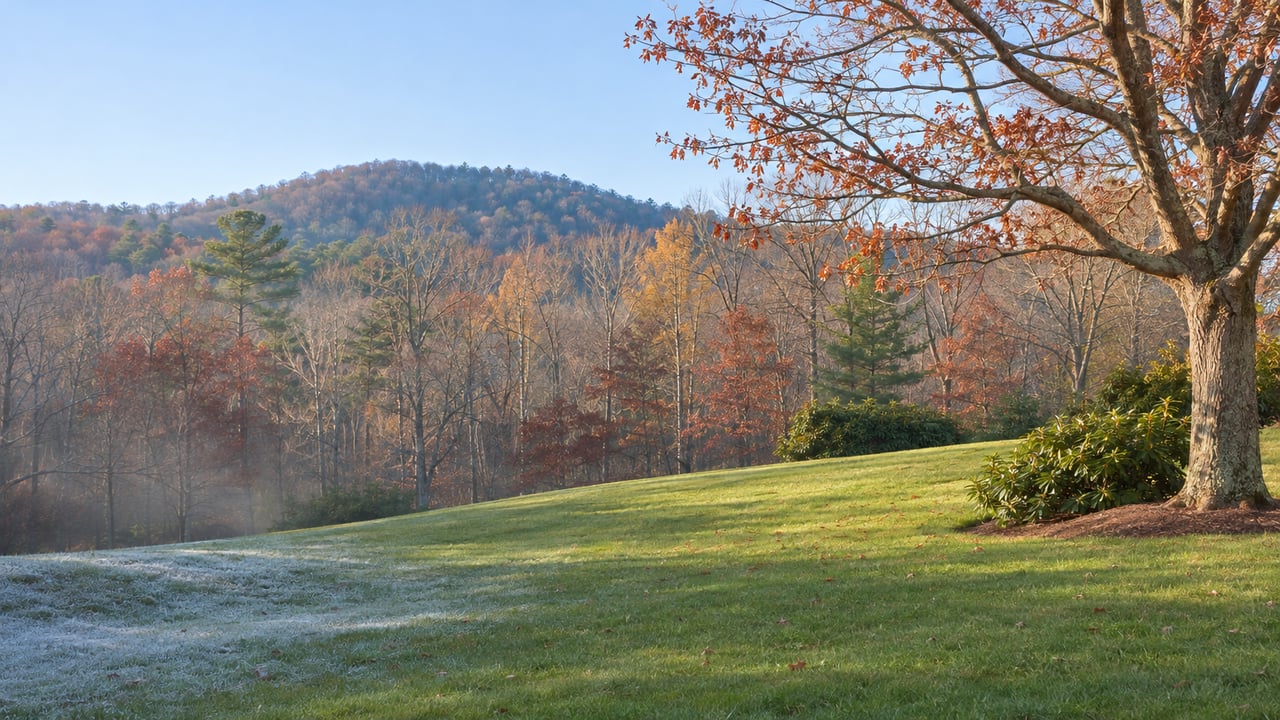
The 1923 report and the Extension guide point to the same clues. Look at which way the slope faces. A south- or southeast-facing slope like Warrior Mountain's vineyard is the classic setting. Look at the lot's height above the valley floor. Tryon's warmest night air was measured a few hundred feet up, not on the Pacolet bottomland and not near the summit. Look at where the cold air can go. Cold air drains downhill and collects in low spots, so a house above an open slope sits differently from a house in a hollow, even at the same elevation.
A frosty morning shows all three on the ground, with white grass where cold air settled and dry grass where it drained past.
Does an address in Tryon mean a home is in the thermal belt? No. The measured effect was on one slope of Warrior Mountain, and its height shifted from night to night. The Pacolet valley floor was the coldest station on frost nights in the 1923 study.
When will a site visit tell me the most? A clear, calm morning after a cold night, which is when cold air drains downslope and inversions form. Tryon's average freeze season runs from November 3 to April 5, based on station records from 1917 to 2019.
If a Tryon slope is on your list this winter, The Light Realty is glad to talk through which parcels are worth a second look on a cold, clear morning. Browse current Tryon homes for sale, read our Tryon neighborhood guide, and schedule your concierge consultation when you're ready.
Stay up to date on the latest real estate trends.

Get In Touch With Our Team To Learn More